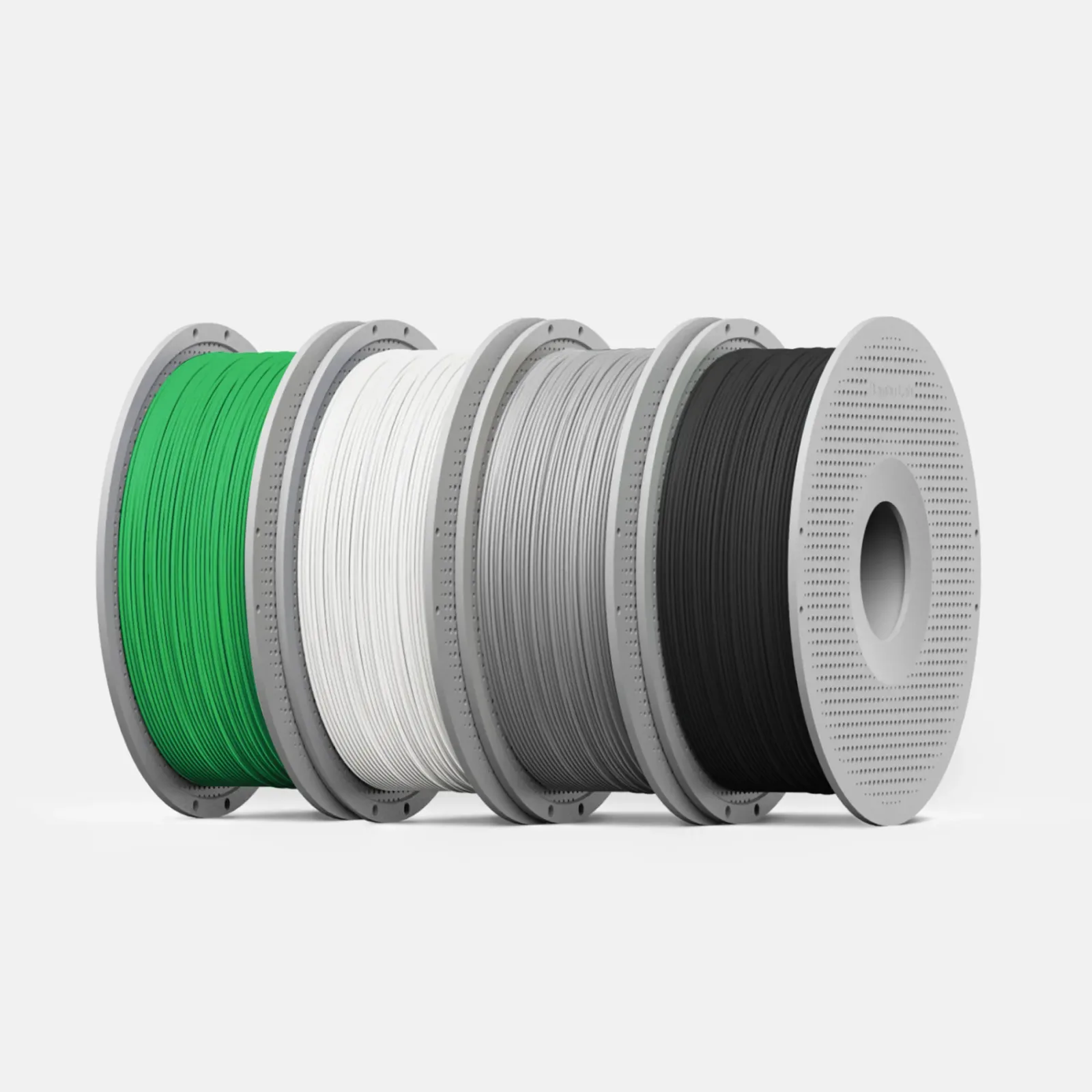
All Materials at a Glance
| Material | Best for | Detail | Toughness | Heat | Outdoors | Cost |
|---|---|---|---|---|---|---|
| PLA | Display, collectibles, gifts | Excellent | Rigid, can be brittle | Low | No | $ |
| PETG | Functional everyday parts | Good | Tough, slight flex | Medium | OK | $ |
| ABS | Tough mechanical parts | Good | Very tough | High | Fades in sun | $$ |
| ASA | Outdoor parts | Good | Very tough | High | Excellent | $$ |
| TPU | Flexible, rubber-like parts | Moderate | Nearly indestructible | Medium | Good | $$$ |
| Nylon | Gears, hinges, wear parts | Moderate | Extremely tough | High | Absorbs moisture | n/a |
| Polycarbonate | Maximum strength & heat | Moderate | Strongest common filament | Very high | Good | $$$$ |
Cost is the material's relative price, from $ for the most economical to $$$$ for the dearest. It's only one part of a quote - print time is usually the bigger factor, as our cost guide explains. Nylon has no tier because we don't currently print it; it's in the table so you can see the full landscape.
Now the detail - what each material actually behaves like once your part is out in the real world.
One thing you won't see in the lists below is "hard to print". Plenty of guides list enclosures, ventilation and warping as cons for ABS, ASA and the engineering plastics - and for someone printing at home, they are. For a part you're ordering from us, they aren't: our Bambu Lab H2C, the top of Bambu Lab's range, is a fully enclosed engineering machine with a heated chamber built for exactly these materials, so that side of it is handled. The pros and cons here are about the part in your hands - how it looks, how it holds up, and what it costs.
PLA - The Display King
PLA (polylactic acid) is the most-used 3D printing material in the world, and it's what we print nearly all of our collector and display work in - usually a matte finish PLA, which hides layer lines and gives that clean, premium, "doesn't look 3D printed" look you see across our shop.
Pros
- The sharpest detail and cleanest surfaces of any everyday filament.
- Huge colour range with vivid, accurate colours - ideal for multi-colour printing.
- Dimensionally stable: corners stay square, large flat parts don't warp.
- Made from plant-based sources, and the most economical material to print in - it's the baseline every quote starts from.
Cons
- Softens at low temperatures - a hot car or sunny windowsill can slowly warp it.
- Rigid rather than tough: a hard drop can crack thin features.
- Degrades outdoors with UV and weather exposure.
Use it for: figures, collectibles, display pieces, keychains, ornaments, prototypes, and anything where looks come first - our Pokeball display sets and dessert tart keychains are both matte PLA. Keep it indoors and away from heat - our care guide covers this in detail.
PETG - The Everyday Workhorse
PETG (polyethylene terephthalate glycol) is the same plastic family as drink bottles, and it sits right between PLA and the engineering materials: tougher and more heat-resistant than PLA while still holding accurate dimensions and a clean finish. We compared the two head-to-head in PLA vs PETG.
Pros
- Tough with a little flex - it absorbs impacts that would crack PLA.
- Handles warm environments, moisture and everyday knocks well.
- Slightly glossy, translucent-capable finish; food-safe grades exist.
- Only a small step up in price from PLA for a big step up in durability.
Cons
- Fine detail comes out slightly softer than PLA, so tiny text and razor-sharp edges are less crisp.
- Scratches more easily than harder plastics.
- Not as UV-stable as ASA for permanent outdoor use.
Use it for: brackets, clips, holders, containers, tool parts, car-interior pieces - functional parts that get handled, warmed or occasionally dropped.
ABS - The Classic Tough Plastic
ABS (acrylonitrile butadiene styrene) is the plastic LEGO bricks are made from. It was the original "strong" 3D printing material and still earns its place for mechanical parts that need to take heat and abuse.
Pros
- High impact strength and good heat resistance (fine around 90 °C).
- Machinable and sandable; can be vapour-smoothed to a glossy, injection-moulded look.
Cons
- Fades and gets brittle in direct sun - that's ASA's job.
- Fewer colour choices than PLA and a plainer finish - pick it for how it performs, not how it looks.
- Costs a little more than PLA for the same part.
Use it for: replacement knobs and housings, automotive parts, jigs, enclosures - hard-working parts that live indoors or under a bonnet.
ASA - The Outdoor Specialist
ASA (acrylonitrile styrene acrylate) is essentially ABS re-engineered for the outdoors. It keeps the toughness and heat resistance but adds genuine UV stability, so parts don't chalk, fade or go brittle in the sun - which matters a lot under an Australian summer.
Pros
- The best UV and weather resistance of the common filaments.
- Tough and heat-resistant like ABS, with slightly better surface finish.
Cons
- Costs noticeably more than PLA or PETG, with a smaller colour range.
- A plain matte finish with less crisp fine detail than PLA - built for fittings and brackets rather than ornate display pieces.
Use it for: garden fittings, outdoor mounts and brackets, letterbox and fence parts, car exterior pieces - anything that lives outside year-round.
TPU - The Flexible One
TPU (thermoplastic polyurethane) is a rubber-like flexible filament. Parts printed in TPU bend, squash, stretch and bounce back - and they're extremely hard to actually break.
Pros
- Flexible and springy, with excellent abrasion and impact resistance.
- Grips surfaces well - great for feet, seals, bumpers and protective parts.
Cons
- Among the pricier filaments and slower to print than rigid materials, so expect a higher quote and a longer turnaround.
- Fine detail is limited by the soft material: crisp edges, small text and thin spikes don't come out well.
Use it for: phone-case-style covers, gaskets and seals, vibration dampers, wheels and tyres for RC models, flexible hinges, protective bumpers and non-slip feet.
Nylon - The Engineer's Choice
A quick note before the spec sheet: our in-house line-up is PLA, PETG, ABS, ASA, TPU, polycarbonate and reinforced specialty blends. Nylon is covered here so you know the full landscape, but we don't currently print it - if your part genuinely needs nylon, tell us the job and we'll advise honestly, including when a part is better sourced than printed. And for the bigger technology question - whether your idea belongs on our printers at all - see the FDM vs resin guide.
Nylon (polyamide, often "PA12" or "PA6") is what you pick when a part has to survive repeated mechanical stress. It's tough, slippery and slightly flexible - the combination that makes gears, hinges and clips last.
Pros
- Outstanding fatigue resistance: living hinges and snap-fits keep working.
- Naturally low friction - ideal for gears, bushings and sliding parts.
- Strong and abrasion-resistant, especially carbon-fibre-filled variants.
Cons
- Absorbs moisture over time, so parts can swell or soften slightly in humid conditions and very tight tolerances may drift.
- Limited colours and a plain, utilitarian finish, at a higher price than the everyday materials.
Use it for: gears, threaded parts, load-bearing clips, tool bodies, drone frames and hard-wearing mechanical replacements.
Polycarbonate - Maximum Strength
PC (polycarbonate) is the strongest filament in common use - the same plastic family as safety glasses and riot shields. When a printed part genuinely must not fail under load or heat, PC is the answer.
Pros
- The highest strength and heat resistance of mainstream filaments (well past 100 °C).
- Rigid yet impact-resistant - takes both load and shock.
Cons
- One of the most expensive filaments, with limited colours, and overkill for most everyday parts.
- Scratches more easily than its strength suggests, and the finish is plain - a structural material, not a display one.
Use it for: structural brackets, high-heat enclosures, protective covers and parts where failure isn't an option.
Specialty PLAs: Silk, Wood, Glow & Carbon-Fibre
Beyond the standard spools, PLA comes in special-effect blends: silk PLA with a shiny metallic sheen, wood-filled PLA that can be sanded and stained, glow-in-the-dark, colour-shifting gradients, and carbon-fibre-filled blends that add stiffness and a matte technical finish. They all keep PLA's easy detail but inherit its heat limits - so treat them as display materials with extra personality, not engineering upgrades. These are the finishes behind a lot of our own work - silk, gradient and translucent blends turn up all through the shop and the Pokeball catalogue, so you can see exactly how each one looks in a finished piece before choosing one for your own print.
How We Choose at Formfinity
Our rule of thumb when quoting a custom print:
- It's for display or a gift → matte PLA, for the sharpest detail and colour.
- It gets used or handled hard → PETG, the durability upgrade that keeps a clean finish.
- It lives outside or near heat → ASA (or ABS indoors).
- It needs to bend or cushion → TPU.
- It's a gear, hinge or wear part → that's polycarbonate territory, or nylon, which we don't currently print - describe the job and we'll tell you honestly what it needs, even if it's something we'd source rather than print in-house.
Tell us what you're making - we'll pick the material
Describe your part and how it'll be used (indoors or out, handled or displayed, hot or cold) and we'll recommend the right material with a free quote before anything gets printed.
Get a Free QuoteDeciding between the two most common options? Read the full PLA vs PETG comparison, see how materials play out in replacement parts, or browse finished pieces in our gallery.