The Short Answer
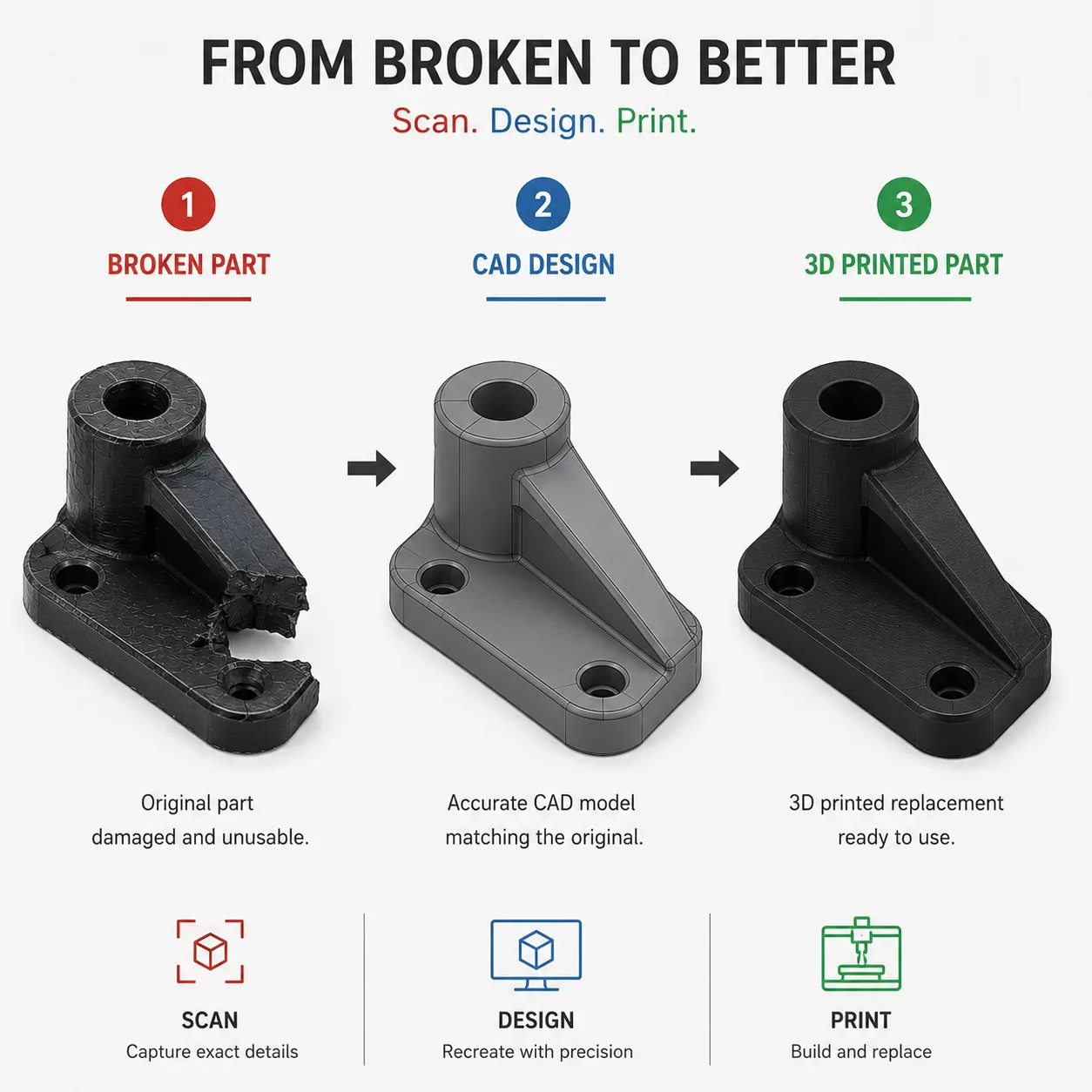
If the broken part is plastic, hand-sized, and not safety-critical - a clip, knob, cap, bracket, hinge cover, spacer, handle or trim piece - there's a very good chance we can reproduce it, often stronger than the original. If the part carries serious loads, lives in high heat, or someone's safety depends on it, 3D printing is usually the wrong tool, and we'll tell you so.
What Works Brilliantly
- Clips and retainers - curtain clips, panel clips, blind brackets, cable holders. Cheap plastic parts that snap constantly and are impossible to buy alone.
- Knobs and dials - appliance knobs, drawer pulls, replacement caps for pots and lids. We can match the spline or shaft shape from measurements.
- Brackets and mounts - shelf pegs, curtain rod brackets, hooks, wall-mount pieces for indoor use.
- Covers, caps and end pieces - furniture feet, tube ends, battery covers, remote-control doors, vacuum attachments.
- Discontinued and obscure parts - the whole reason this niche exists. If a sample or clear photos with measurements exist, the part can usually be recreated.
- Improved versions - the original snapped for a reason. Printed replacements can be thickened, reinforced or printed in a tougher material so the weak point doesn't come back.
What Doesn't Work (And Why)
- Safety-critical parts - anything where failure could hurt someone: ladder feet taking full body weight, brake or steering components, load-bearing child-seat or harness pieces. Hard no, no matter how printable it looks.
- High-heat engine and oven parts - parts that live next to an engine block, inside an oven, or against heating elements exceed what printable plastics handle. (Warm spots like a car cabin are fine with the right material - see below.)
- Fine machine threads - coarse threads print well; fine metric threads under load are better handled with a brass insert or a redesign, which we can advise on.
- Optically clear parts - printed "clear" is translucent at best, so lenses and display windows disappoint.
- Food-contact and dishwasher parts - printed layers can trap residue and most filaments aren't certified food-safe, so we don't recommend printed parts for direct food contact.
Picking the Right Material
Material choice makes or breaks a replacement part. As a rule of thumb: PETG for everyday handled parts and anything slightly warm or damp, ABS or ASA for tough parts and anything living outdoors or in a hot car, and flexible TPU for feet, seals and bumpers. The full trade-offs are in our 3D printing materials guide - but you don't need to choose. Tell us how the part is used and we'll pick.
What It Costs
Most replacement parts fall at the small end of custom printing - typically in the $20–$35 range for a small single part, with tiny clips at the lower end and larger or multi-part jobs quoted individually. If the part needs to be modelled from scratch (no STL file exists), the measuring and design time is quoted up front too. The full picture is in our guide to custom 3D printing costs in Australia, or get an instant ballpark from the estimate tool.
How to Get One Made
You don't need a 3D file - most replacement-part jobs start with photos. Send us:
- Photos of the broken part from a few angles (and where it fits).
- Measurements - length, width, holes and diameters with a ruler or callipers. Even rough numbers help.
- How it's used - indoors or out, load or no load, near heat or moisture. This decides the material.
- The broken original, if posting it is practical - the best reference there is.
Already have an STL from the manufacturer or a maker site? Even easier - see our STL preparation guide, then send it through.
Got a broken part? Send us a photo
Describe the part, add photos and rough measurements, and we'll tell you honestly whether it's printable, what material it needs, and what it'll cost - before anything is made.
Get a Free QuoteCurious what else custom printing covers? See the custom 3D printing service or browse finished work in the gallery.