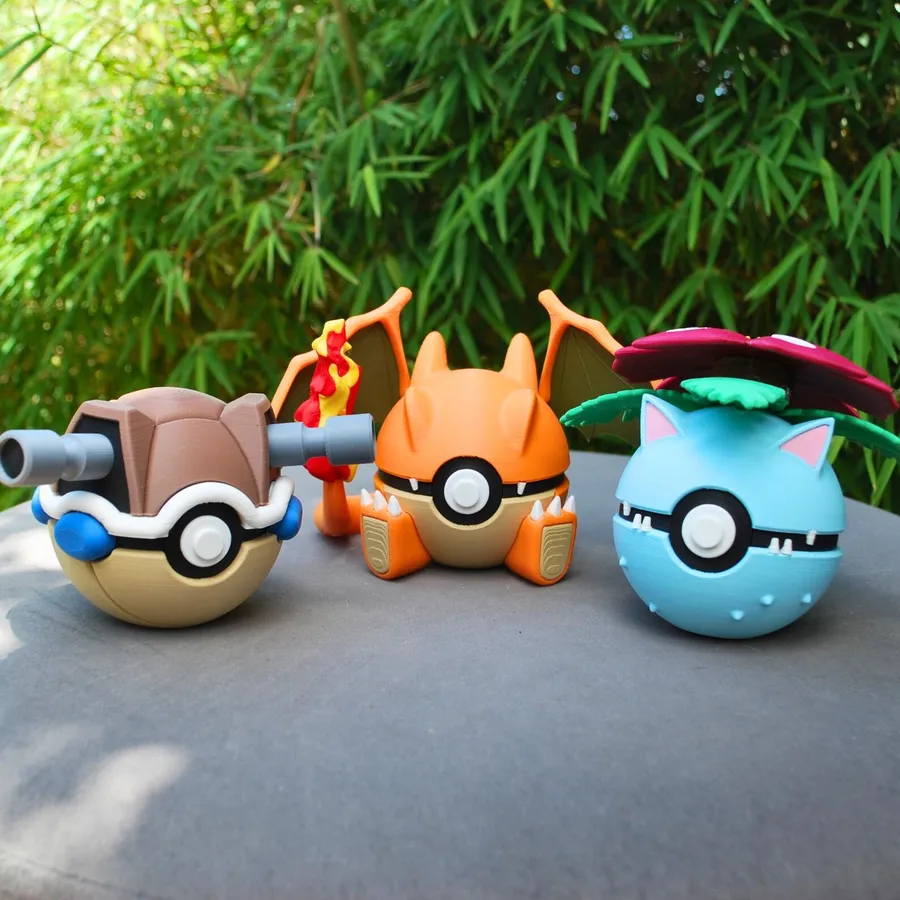
Printed, Not Painted
A multi-colour 3D print is built from several spools of filament in the same job. When the printer reaches a part of the model that needs a different colour, it swaps to that spool, primes the new colour and keeps building. The result is colour that goes all the way through the plastic: it can't chip, scratch off or fade the way paint does, and every boundary between two colours is as sharp as the model itself.
That's a big deal for collectibles and gifts. A hand-painted figure needs sealing and careful handling; a multi-colour print can be picked up, used as a keychain or handled at a market stall for years and the colour stays exactly where we printed it.
How the Printer Changes Colour Mid-Print
The magic ingredient is the AMS - the Automatic Material System. Each AMS unit sits on top of the printer and holds four spools. The printer pulls filament from whichever spool the current section of the model needs, and switching is fully automatic: the old colour is retracted, the new one is fed in, and a small amount is purged so the colours never smear into each other.
We run two AMS units, so eight different filaments can be loaded for a single job. That might be eight colours of the same material, or a mix - say, six colours of PLA plus a support material for tricky overhangs. The machine also sequences every swap for the most efficient changeover it can, keeping purge waste and switching time to a minimum - which matters when a colourful piece involves hundreds of changes.
Colour isn't limited to simple bands or layers either. The model is "painted" digitally in the slicing software before printing, so different colours can appear side by side on the same layer - an eye, a logo, a pattern wrapping around a curve. If it can be painted on the digital model, it can usually be printed.
The Machine Behind It
Our workhorse is a Bambu Lab H2C with two AMS units on top. The fully enclosed chamber keeps temperatures stable, which matters for large display pieces (fewer warped bases, cleaner surfaces) and lets us print engineering materials like ABS and ASA that need a warm, draft-free environment. It's also simply fast - colour changes add time to a job, so a quick, reliable machine is the difference between a two-day turnaround and a week.
Nozzle choice is the other lever. We can fit hotends from 0.2 mm up to 0.8 mm: 0.2 mm for miniature detail, fine lettering and the sharpest colour boundaries, and 0.8 mm for big, strong parts that would otherwise take days to print. For most work we run the 0.4 mm nozzle - the sweet spot of detail, strength and speed that suits nearly every display piece and functional print we make.
Multi-Colour Print vs Hand-Painting
| Property | Multi-colour print | Painted print |
|---|---|---|
| Colour durability | Solid through the part | Surface only, can chip |
| Consistency | Identical every time | Varies piece to piece |
| Fine boundaries | Razor sharp | Depends on the brush |
| Safe to handle daily | Yes | Needs sealing |
| Turnaround | One machine step | Print + paint + dry |
Which Materials Can Be Multi-Colour?
PLA - the display king
Nearly all of our collector and display work is multi-colour PLA, usually in a matte finish. It holds the widest colour range, prints the crispest boundaries, and the matte surface hides layer lines beautifully. The Eeveelution Pokeball displays and the Dim Sum Clicker Collection are both printed exactly this way. If you're after a figure, keychain or gift, this is almost always the answer - see our PLA vs PETG guide for the details.
PETG and ABS/ASA - functional colour
Functional parts can be multi-colour too: colour-coded brackets, two-tone housings, a logo printed into a panel. PETG handles heat and moisture better than PLA, and ABS/ASA suit tough or outdoor parts - the enclosed chamber makes these reliable for us where open printers struggle.
TPU and specialty filaments
Flexible TPU prints brilliantly (our flexi keychains are printed in PLA with flexible print-in-place joints) but usually in a single colour per part. Silk, glitter and other specialty finishes can join a multi-colour job as accent colours. For the full rundown of what we stock, our materials guide covers every option.
What Colour Changes Mean for Price and Time
Every colour change takes a little time and purges a little filament, and a detailed multi-colour piece can involve hundreds of changes across a job. That's why a six-colour display piece costs more than the same model in one colour - it genuinely uses more machine time and material, not because colour carries a made-up premium. When you request a quote we'll tell you exactly how the colour count affects the price, and where trimming a colour (or combining two similar shades) can save real money. Our cost guide explains the other price drivers.
What We Make With It
- Collector display pieces - like the Pokeball-inspired sets in our Pokeball catalogue.
- Multi-colour keychains and small gifts, printed in matching sets.
- Signs, logos and nameplates with colour printed into the face.
- Colour-coded functional parts - workshop fixtures, labelled housings, replacement parts that match the original's colour.
Browse the shop for ready-made multi-colour pieces, or check the gallery to see the finish quality up close.
Have a colourful idea?
Send us the design, reference images or even a rough sketch, tell us the colours you're imagining, and we'll confirm what's printable and quote it before anything is made. Up to 8 colours, no painting required.
Get a Free QuoteNew to custom printing? Start with how our custom service works or read up on preparing your STL files.